
Direction Before Effort
How the way you think determines where you end up

You’re Not Steering
Most people are convinced they’re in control of their lives. They’re not.
Everyone wants something. A better career, a stronger body, more freedom, a different kind of life. We set goals, work toward them, and assume that effort will get us there. What we rarely question is whether we’re moving in the right direction.
But most people don’t end up where they intended. Not because they didn’t try, but effort only matters after direction is set. And one reason direction goes wrong is that we often mistake our internal model of reality for reality itself, something I explored more directly in The Reality Gap.
Two people can apply the same discipline and end up in completely different places, not because one tried harder, but because one was navigating and the other was drifting.
How you think determines where you end up.
Think about your life moving like a river delta. The current is time, carrying you forward at a constant speed. You can’t slow it down, you can’t speed it up, and you can’t stop. The river keeps splitting into channels. Your past is fixed, a single path behind you. Your future is open, branching into thousands of possible directions.
The present is the only place where you make decisions, the only moment where you get to choose direction. And even not making a decision is a decision in itself. The current will carry you somewhere regardless.
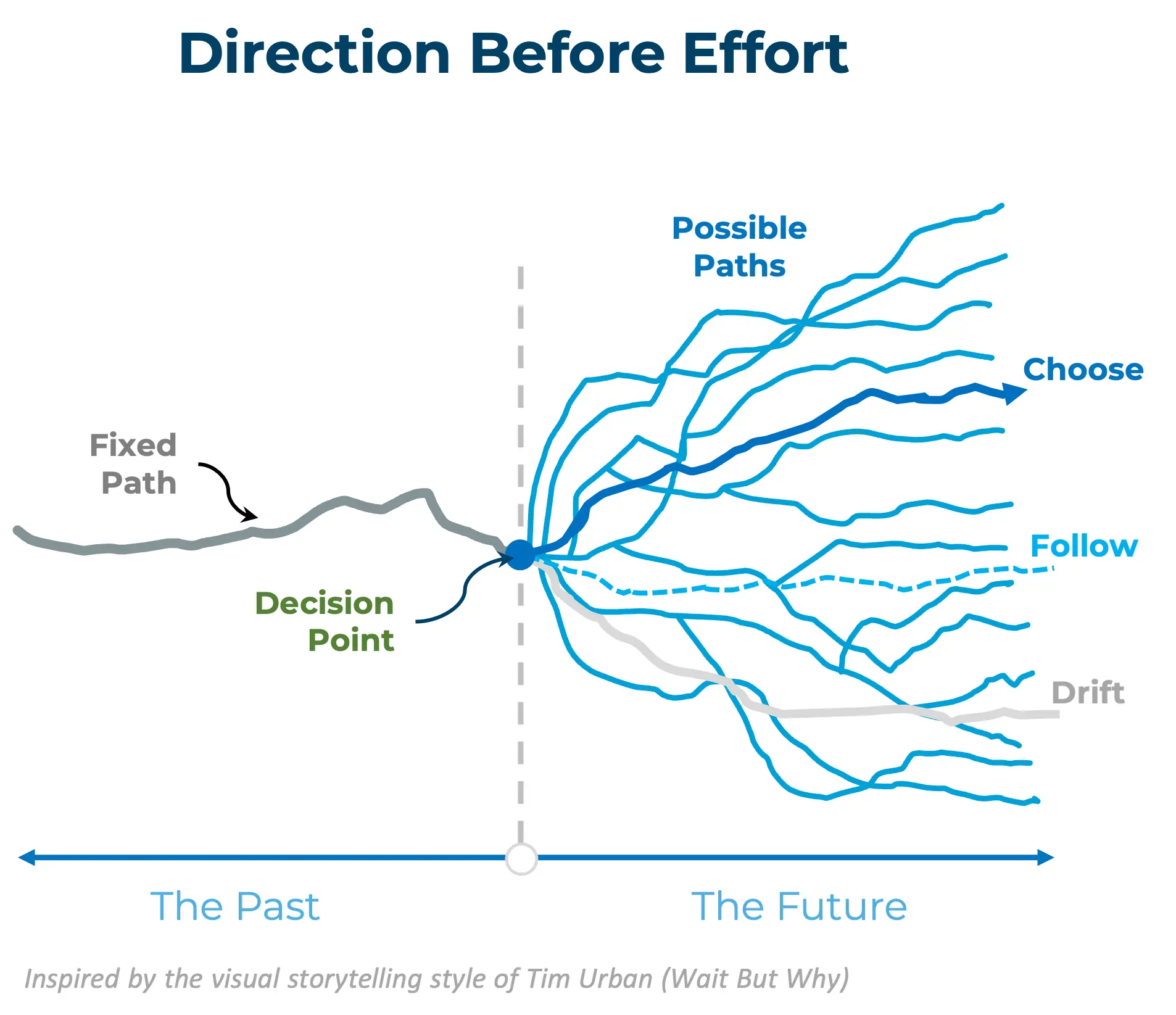
There are three ways people navigate this, each with a very different relationship to direction.
Three Ways of Thinking
There are many ways to categorize how people think. This is one lens, a simple, practical way to look at the relationship between thinking and direction. These aren’t personality types. They’re modes we all move through, often without realizing which one we’re in.
Automatic Thinking
This is where most of life happens. More than you’d expect.
Daniel Kahneman’s research on fast and slow thinking confirms what neuroscience has pointed to for decades: roughly 95% of our cognitive activity operates below conscious awareness. Your brain runs on shortcuts, habit, instinct, pattern recognition. The mind optimizes for efficiency, not accuracy.
For most of human history, stopping to evaluate every situation would have gotten you killed. Speed kept you alive. So the subconscious took over.
Think about what happens between your alarm going off and arriving at work. You make the coffee, shower, get dressed, grab your keys, and drive the same route. Dozens of decisions, almost no conscious thought. The sequence runs on autopilot, exactly as designed.
This works beautifully for routine. But it also means that when the subconscious steers, direction becomes accidental. You’re moving, but you’re not choosing where.
Most of the time that’s fine. Autopilot lands you somewhere reasonable. But “reasonable” and “where you actually wanted to go” are not the same thing.
Borrowed Thinking
This feels like an upgrade, and often it is.
You’re more deliberate now. You seek input, weigh advice, make conscious choices. But the models underneath those choices aren’t yours. They come from parents, mentors, managers, culture, people you admire. You’re choosing, but through someone else’s lens.
This has deep evolutionary roots. For thousands of years, following trusted leaders was one of the smartest moves available. The tribe elder had experience, context, and their interests were aligned with yours. When they said the eastern path was dangerous, you listened.
When it comes to borrowed thing there are two group types that you have to be aware of:
First is the group of people who have your best interest in mind: close family, mentors, people who know your situation and have earned credibility over time. Nurture and grow this group. Borrowing thinking from them is one of the smartest things you can do.
Trusting the second group blindly is what gets you in trouble. Politicians, media figures, influencers, institutions with their own agendas. They say they care. Most of the time, they don’t. Their incentives point somewhere else. When a political leader tells you what to believe, they’re borrowing the format of tribal trust to serve their own goals. And it works, because the instinct to follow a confident voice is still running in our hardware.
The skill with borrowed thinking is choosing consciously who you trust. Not everyone offering direction deserves your attention. Be deliberate about whose map you follow.
What makes this harder than it sounds is that borrowed ideas don’t stay borrowed. Over time they become part of how you see yourself. An opinion absorbed from a parent at fifteen feels like a core belief by thirty-five. You defend it not because you’ve examined it, but because questioning it feels like questioning yourself.
Jonathan Swift captured this perfectly:
“You cannot reason a man out of a position he did not reason himself into.”
The belief didn’t enter through examination. It entered through absorption. Trying to argue someone out of it with evidence is like trying to unscrew a nail. Wrong tool for how it got there.
Directed Thinking
This is where the shift happens.
You stop relying on momentum or external direction and start constructing your own. You question assumptions, including the ones you’ve carried so long they feel like facts. You observe what actually works rather than what you were told should work.
This doesn’t mean ignoring others. It means not outsourcing your judgment. You can take input, but you run it through your own filter. You test it against reality, against your goals, against your constraints. The difference is not exposure to ideas. It’s ownership of the final call.
Directed thinking is the most expensive mode. It requires time, attention, and energy your brain is designed to conserve. Unlike automatic thinking, which feels like nothing, or borrowed thinking, which feels productive and validated, directed thinking often feels uncomfortable. It produces answers that contradict what you want to believe or what your group believes.
It also carries responsibility. When the direction is yours, so are the outcomes. There’s no one else to point to if it doesn’t work.
But it’s the only mode where the direction is genuinely yours. The uncertainty doesn’t disappear. You still operate with incomplete information. But the ownership changes.
Direction Is the Difference
We all want to move toward something: goals, outcomes, a version of life worth building. The question is not whether we move, but whether our movement is aligned with what we actually want.
Back to the delta metaphor. The river keeps splitting, and each mode of thinking navigates those forks differently.
With automatic thinking, the current decides. You drift into whichever channel you happen to follow. You might end up somewhere good. You might not. Your goals have little influence over the path. You basically surrendered agency for randomness.
With borrowed thinking, you steer but based on someone else’s map. If the source is trustworthy and their map fits your situation, this works. If not, you follow confidently in the wrong direction.
With directed thinking, you take control of the direction. You still move within the same constraints, limited visibility, no ability to pause the current. But the direction is yours.
The difference between these paths is not effort. It is direction.
Where This Matters
Not every fork deserves deep examination. Most don’t. Your morning routine, your commute, your lunch: let automatic thinking handle those.
Borrowing from trusted people is one of the most efficient ways to navigate unfamiliar territory. These modes aren’t failures. They’re features.
The problem shows up at the forks that compound. Some decisions disappear by tomorrow. Others quietly shape the next decade.
A career path chosen on borrowed logic narrows your options in ways you won’t notice until much later. A belief absorbed at twenty hardens into identity by forty and filters every decision in between.
Each choice made on autopilot quietly limits what remains possible later.
Those are the forks that deserve directed thinking. Career direction. Relationships. Core beliefs about who you are and what you’re capable of.
How do you spot them? If a decision will shape the next several years, it deserves more than autopilot. And if you hold a strong belief but can’t remember when you last examined it, that’s a flag.
Strong conviction with zero examination is almost always borrowed thinking in disguise.
The Real Question
You are moving forward no matter what. Time doesn’t pause and the river doesn’t stop splitting. Decisions will be made, paths will be taken, outcomes will unfold, with or without your input.
The only real question is who is steering when those forks appear.
Are you drifting, following, or choosing where you end up?
That answer shapes everything that comes next.
Continue exploring:
How to structure direction → The Alignment Model
How to think under uncertainty → Probabilistic Thinking