
The Clarity Framework: Building a Better Map of Reality
How to narrow the gap between the world as it is and the version in your head.

We Don’t See Reality Directly
Most of us go through life believing we see reality clearly. We don’t. What we experience is a compressed, filtered, emotionally shaped version of the world, and then we mistake that version for the world itself.
This is not a small error at the edges of perception. It runs underneath almost everything. We act on our interpretation of a situation, not the situation itself. We read people through the stories we’ve built about them.
And the decisions that shape a life get made from a picture in the head that feels complete and usually isn’t. We rarely stop to check, because the version we live in does not feel like a version. It feels like the truth.
That is the part that should unsettle you. Certainty is not proof that you are right. It is a sign your model feels complete, which it can do whether or not it matches reality. And the more certain you feel, the less you tend to look for the evidence that would change your mind.
Most of life runs downstream from this. The accuracy of the version you carry shapes your decisions, your relationships, your fears, your sense of what is possible, and where you aim your effort. Get it wrong and everything built on top inherits the error.
You can be disciplined, motivated, and sharp, and still move with total confidence in the wrong direction, because effort applied to a distorted picture only gets you somewhere wrong faster.
This is why thinking sits beneath everything else we try to fix. We pour energy into working harder, building habits, staying motivated, and all of it rests on a quieter layer underneath: how accurately we understand what is actually going on.
That layer is almost never examined. It is the hidden mechanism running under a huge part of human life.
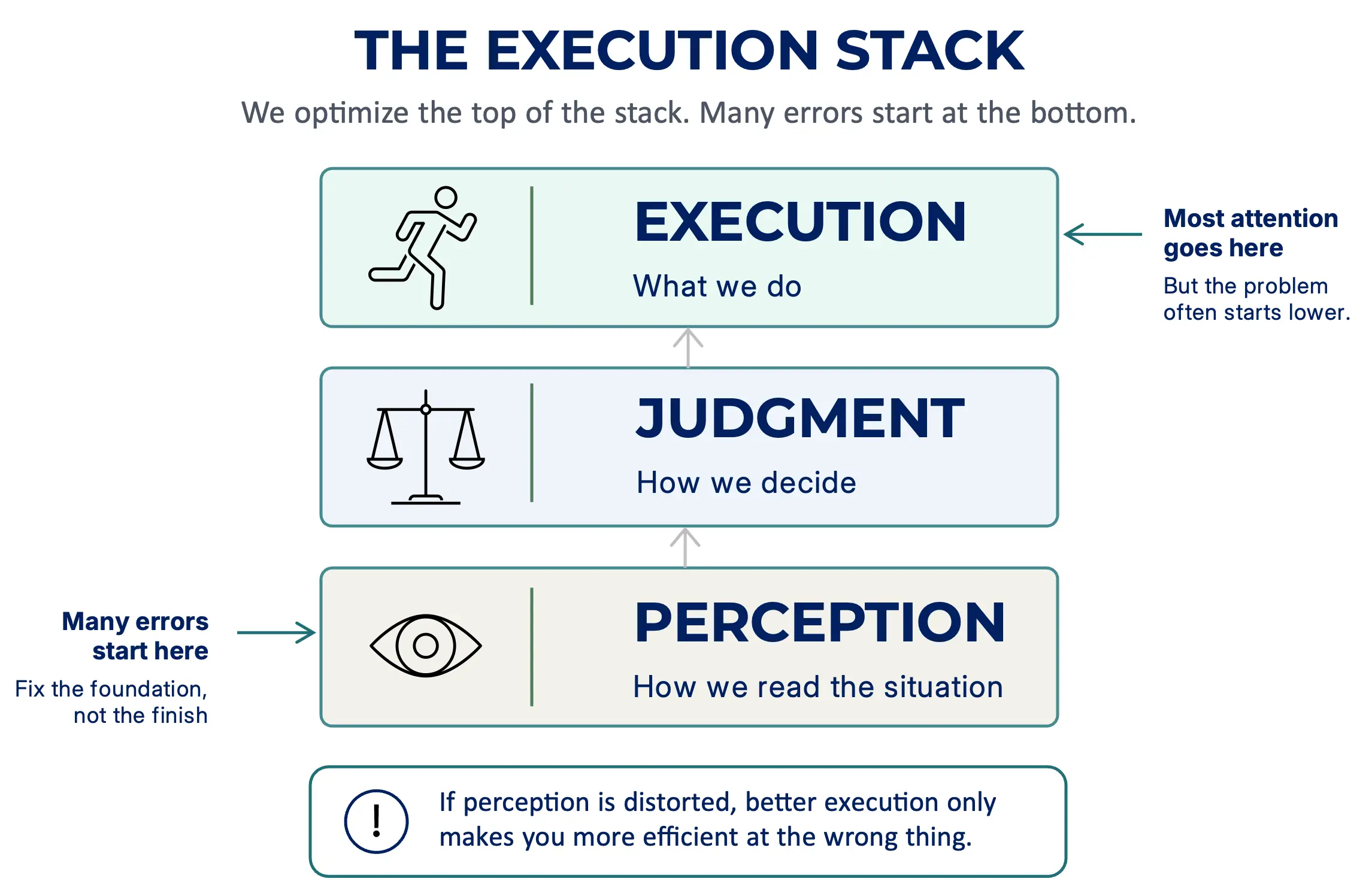
Clear thinking is the work of examining it. Perfect truth isn’t available to anyone, so the goal is humbler and more useful: sharpen the accuracy of that internal picture, especially where being wrong is expensive.
The Clarity Framework is a system for improving the model we navigate by.
The Gap Between Map and Territory
Reality is the territory. It is the world as it actually is: other people’s real intentions, the actual constraints around a problem, the causes operating underneath the surface, the consequences that will arrive whether you anticipated them or not.
We never hold the full territory in our minds. We can’t. It is too large and too layered for direct access. So the mind does what any navigator does when the terrain is too vast to see whole.
It builds a map.
This idea, known as the map–territory relation, comes from Alfred Korzybski, who wrote in 1933 that “the map is not the territory.” A representation is never the thing it represents. The mind has no choice but to work from one anyway.
The map is your internal model of reality. It is shaped by what you have noticed, what you remember, what you believe, what you were taught, what you fear, what you want, and what happened last time something looked like this. It is compressed, simplified, and built for speed.
And it is useful. Without it, you could not make a single decision. You would stand paralyzed in front of every situation, unable to filter signal from noise.
But the compression comes at a cost.
A road map leaves out trees, weather, traffic, and the crack in the pavement that will matter when it rains. The mind’s version leaves things out too. Details that seemed irrelevant. Variables you did not notice. Assumptions so old they feel like facts. Interpretations that arrived so fast they felt like observation.
Some of what gets left out never matters. Some of it matters enormously. That distance between the territory and the version in your head is the Reality Gap.
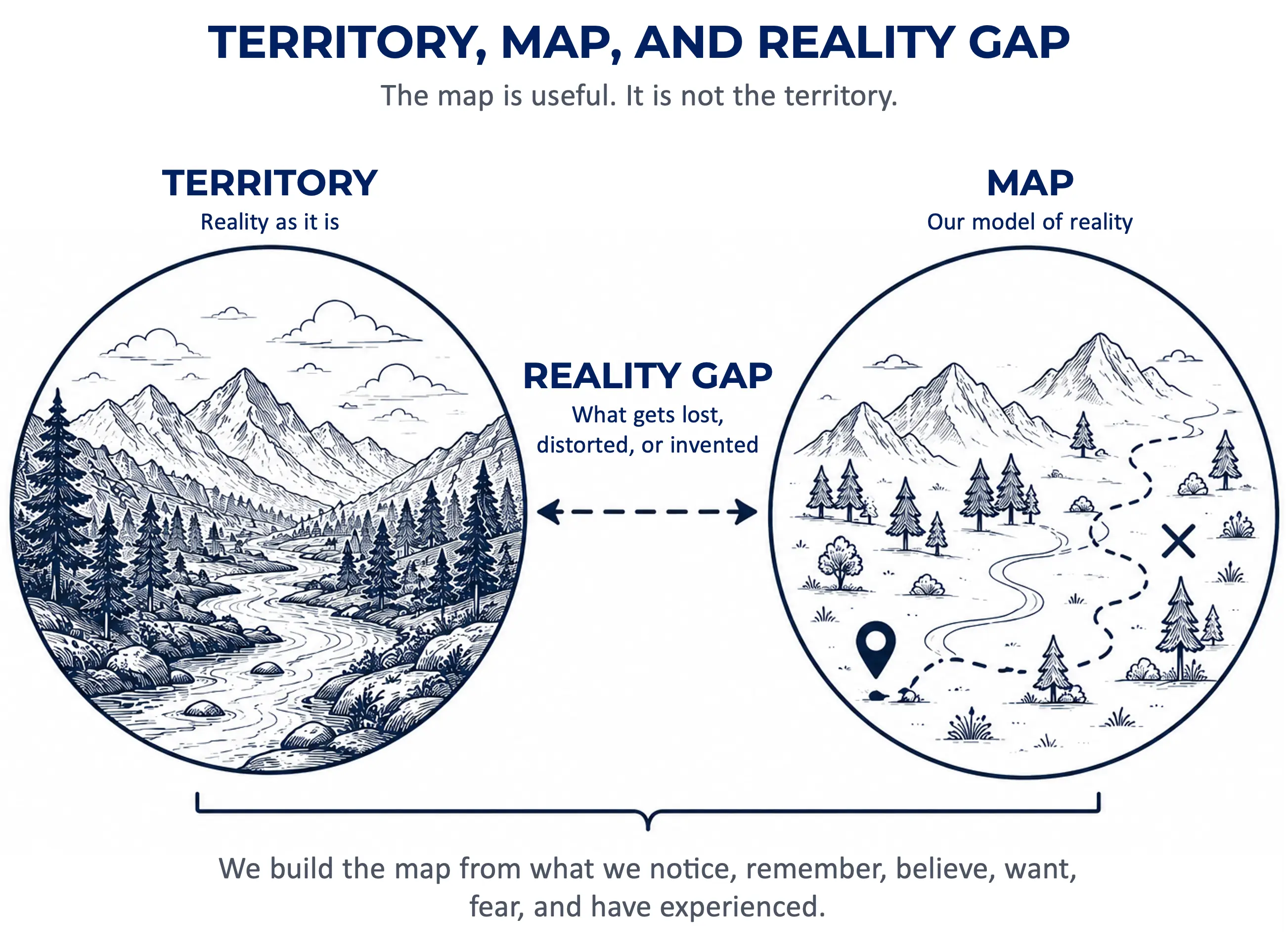
When the gap is small, your read works well enough. Decisions land, and effort connects to results. When the gap is large, things break in ways that are hard to diagnose, because from the inside, everything still feels right.
The Clarity Framework exists because the Reality Gap exists.
And almost everything else worth doing with your mind, learning, sharper judgment, wiser decisions, growth itself, is the same act in this language: closing the distance between the map and the world.
Clear Thinking Is Map Improvement
Clear thinking is how you close that distance on purpose.
Not perfectly. You cannot step outside your own mind and see reality bare. You cannot remove every bias, catch every assumption, or account for every variable. The territory will always be larger than the map.
But it can get better.
It does not need to get better everywhere. The map is too large to sharpen all at once, and most of it does not matter much. So the work is selective. You go deep where the stakes are highest, the decisions that compound and the beliefs you build a life on, and let the rest stay rough.
Attention is what decides which part gets sharpened. Whatever you don’t look at stays blurry, or missing entirely.
Clear thinking is the discipline of improving it on purpose. It means noticing where the view may be distorted, questioning what feels too obvious, and updating when reality pushes back. Sometimes it means tearing the whole thing down and rebuilding when the foundation turns out to be weaker than it felt.
This is not about being smarter. It is about being more honest with yourself: what you actually know versus what you assume, what you observed versus what you interpreted, where your confidence is earned versus where it just showed up on its own.
The framework works through three movements:
Perception is about noticing the map being built. Seeing that interpretation is already happening before you have consciously evaluated anything.
Judgment is about improving it. Using specific thinking tools to update, test, simplify, rebuild, or connect your understanding.
Agency is about putting it to use. Letting clearer thinking change where you aim and how you move.
The sequence is simple: see more clearly, think more accurately, act with better direction.
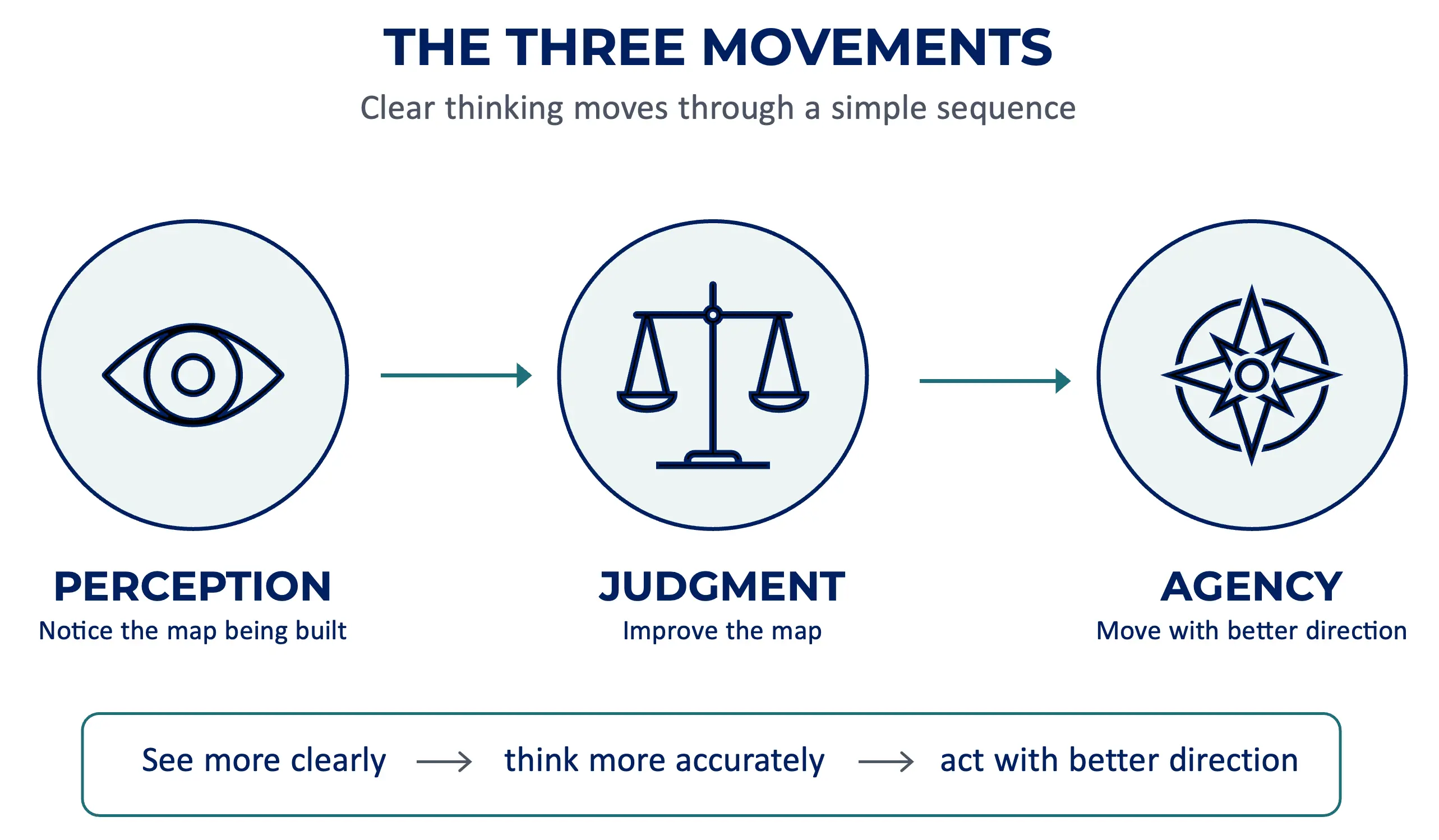
The rest of this article walks through those three movements. After that, I’ll show how the published and upcoming pieces fit into the larger framework.
Perception: Noticing the Map
Perception is where the map gets drawn.
Most people think perception is passive. Something happens, and we see it. Someone speaks, and we hear what they said.
But that is not what happens. The mind does not record. It constructs. It selects what to pay attention to, filters out what seems irrelevant, fills gaps with assumptions, and attaches meaning so fast that the finished product arrives feeling like plain observation.
By the time you “see” what happened, the interpretation is already built in.
Here is a simple example. Your boss replies to a project update with two sentences: “Looks fine. Let’s discuss Thursday.”
The territory is a few words on a screen. That is all that actually happened.
But the picture fills itself in. “Fine” sounds lukewarm. “Let’s discuss” sounds ominous. By Thursday, you have rehearsed three versions of the conversation, adjusted your tone, and walked in slightly defensive, all because of what your mind did with two neutral sentences.
The meaning you attached might be right. Your boss might genuinely be underwhelmed. But it might also be completely wrong. They might have been between meetings, skimmed the update, thought it was genuinely fine, and moved on. “Looks fine” might be exactly what it says.
You will not know until you check. But your mind did not wait for you to check. It filled in the blanks and presented the result as fact.
This is not a flaw in how you think. It is how the system works. The mind resolves ambiguity fast because in most situations a quick read is better than no read at all. The problem shows up when we treat that first read as the final answer.
The first movement of the Clarity Framework is learning to catch that moment.
What actually happened, stripped of interpretation? What story did my mind attach to it? What else could explain this? What would I need to know before turning this into a conclusion?
These questions are simple. Applying them is hard, because the mind does not present its first interpretation as a draft. It presents it as the truth. That is why this matters. The first read is often right. It is never complete.
Perception tools help separate what happened from what we think happened. They slow the first story down long enough to notice it is a story.
Before we can think better, we have to see what we are actually thinking with.
Judgment: Improving the Map
Noticing the map is the first step. But awareness alone does not fix a distorted picture. Once you see that your understanding may be incomplete, you need ways to actually improve it.
This is the judgment layer of the framework.
It breaks in different ways, and different failures need different corrections.
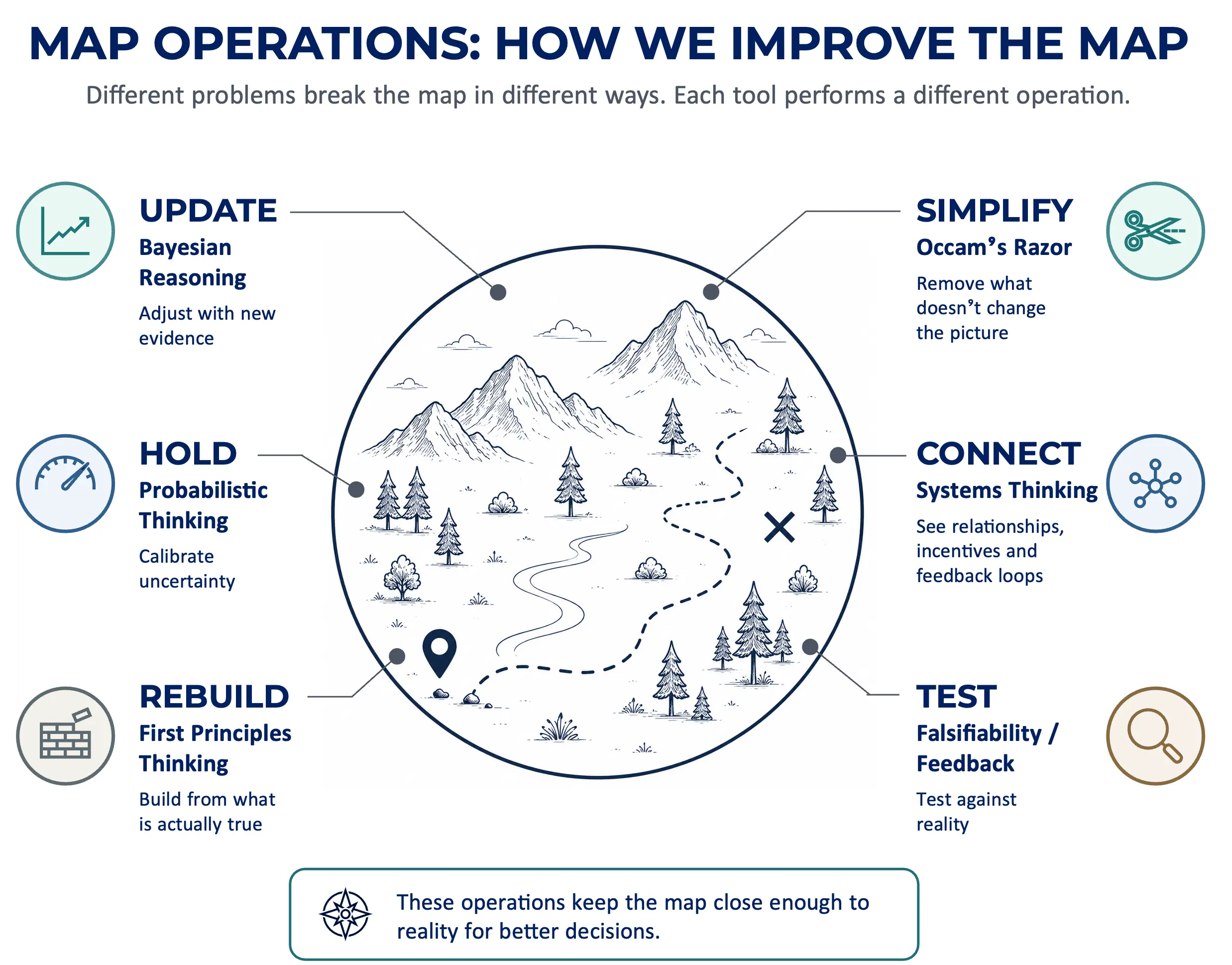
Sometimes the map will not update. You encounter new information, clear evidence that something you believed is not quite right, and the picture resists. The old version feels solid. The new evidence feels like noise.
This is where Bayesian reasoning helps. It asks a precise question: given this new evidence, how much should my confidence actually shift? Not “should I change my mind completely?” but “does this warrant a meaningful update?”
Good judgment moves in proportion to evidence. It does not cling to the old version out of comfort, and it does not redraw everything every time a weak signal appears.
Sometimes the map is too rigid. We collapse a spectrum of possibility into a binary: this will work or it won’t, this person is competent or they aren’t, this decision is right or wrong. Reality almost never runs in two categories.
Probabilistic thinking loosens it. It replaces false certainty with calibrated confidence and lets you hold a position at 70% without pretending you are at 100%.
Sometimes the foundation is wrong. You have been reasoning carefully, updating responsibly, and the conclusions still do not hold up. The problem is not the updates. It is the starting structure. The assumptions underneath were inherited, borrowed, or accepted without examination, and everything built on top carried the original error forward.
First principles thinking strips the model back to what you can actually verify and rebuilds from there.
Sometimes the map has too many lines. Complexity accumulates. Every exception, every edge case, every “it depends” adds another layer until the model becomes too detailed to use. Occam’s Razor is the correction. Not oversimplification, but earned simplicity. Remove what does not change the picture meaningfully. Keep what does.
Sometimes the map treats everything as separate when it is not. You analyze one variable, one person, one decision in isolation and miss how they connect. Incentives shape behavior, feedback loops change outcomes, and small causes ripple into large second-order effects. Systems thinking fills in the relationships between the landmarks.
And sometimes the map cannot be tested at all. A belief feels coherent, elegant, persuasive, and there is no way to challenge it. No evidence could change it. No outcome could disprove it. A model that cannot be wrong is not a map. It is a fixed picture that will never update no matter what reality does. Falsifiability, critical thinking, and honest feedback keep it accountable to something outside itself.
These tools do different work on different problems. What connects them is the function: keeping the map close enough to reality that the decisions built on it have a better chance of working.
Agency: Using the Better Map
A clearer picture should change how you move. Otherwise clarity is just a spectator sport, something you appreciate intellectually but never act on.
Here is where it gets concrete.
Someone says: “I need to work harder to get promoted.”
That sentence feels like a plan. It has a goal (promotion), a strategy (more effort), and a built-in diagnosis (not working hard enough). It sounds ready for action.
But every part of it is a map.
It assumes the goal is clear and well-defined. It assumes the path to promotion runs through effort. It assumes the system rewards intensity directly. It assumes the missing ingredient is more of what you are already doing.
Any one of those assumptions could be wrong.
The real obstacle might be visibility. The people making the decision might not see your work clearly enough to evaluate it. It might be scope: you are excellent at your current level, but you have not shown the thinking the next level requires. It might be relationships, timing, the absence of an open role, unclear feedback, or a gap between how you see your contributions and how the decision-makers see them.
If the map is wrong, working harder does not fix the problem. It deepens it. You push further in a direction that was never going to get you there, and the effort itself becomes evidence (to you) that you have earned the outcome. When it does not arrive, the conclusion is usually “the system is unfair” rather than “my read was incomplete.”
That entire chain started with one unexamined sentence.
Agency begins with direction, not movement.
A better one changes the question. Instead of “how do I push harder?” it becomes “where should effort actually go?” Does effort have leverage here, or am I pressing the accelerator in neutral? Are the constraints real, or am I treating soft limits as hard ones? Is the process clear enough to produce results? Does feedback exist, and am I paying attention to it?
The quality of the map determines the quality of the route. And the route determines where effort takes you.
How the Framework Fits Together
The pieces below are the larger framework this article is organizing. Some are already published. Others are still being developed. Each one sharpens a different part of the map: perception, judgment, direction, uncertainty, blind spots, assumptions, or action.
Perception: noticing the map
How the mind filters, distorts, invents, or misses parts of reality.
The Reality Gap — defines the distance between reality and the version we carry in our heads.
We React to Stories, Not People — separates events from the stories the mind attaches to them.
What You Don’t Know You Don’t Know — shows how missing terrain can feel like completeness.
Perception vs. Reality — applies the Reality Gap to reputation, visibility, and workplace judgment.
Attention Creates Reality — explains how attention determines what enters the map.
Contrast and Understanding — explores why we understand things through comparison, not isolation.
Meta-awareness — helps us notice the map being built in real time.
Judgment: improving the map
How we update, test, simplify, rebuild, and connect our understanding.
Bayesian Reasoning — updates the map when better evidence appears.
Probabilistic Thinking — keeps the map flexible under uncertainty.
The Illusion of Certainty — separates decision quality from outcome quality.
First Principles Thinking — rebuilds the map from what is actually true.
Why Being Wrong Feels Like Being Right — explains why a wrong map can feel complete from the inside.
Deep vs. Surface Thinking — distinguishes real understanding from familiar labels.
Occam’s Razor — simplifies the map without oversimplifying reality.
Systems Thinking — connects the map through relationships, incentives, feedback loops, and second-order effects.
Falsifiability and Testability — tests whether a belief can survive contact with reality.
Critical Thinking — integrates the tools into a deliberate way of evaluating claims, assumptions, and conclusions.
Agency: using the better map
How clearer thinking becomes better direction and action.
Direction Before Effort — shows why effort only matters after direction is set.
The Structure of Effective Goals — defines the starting point, destination, system, and execution.
How to Set Goals That Actually Work — explains how constraints, interference, feedback, and leverage determine whether effort works.
Identity, Direction, and Container — explains how personal structure shapes movement.
Constraint Navigation — distinguishes hard limits from movable boundaries.
The point is not to collect more concepts. It is to understand what each one does to the map.
The Map Is Never Finished
The map is always a draft.
Reality does not hold still. New evidence appears and old assumptions expire. People change, systems shift, and so do you. What worked last year may not work now, and what felt obvious yesterday may look different with one new piece of information.
That is not a reason to question every thought or distrust every instinct. Most of daily life runs fine on the version you already carry. The mind needs shortcuts. Not every moment deserves examination.
But some moments do.
A belief shaping a career. A judgment hardening about someone you work with. A goal that has quietly eaten years. An interpretation slowly straining a relationship. Those are the places that deserve a harder look. You are not necessarily wrong in any of them. But the cost of being wrong without realizing it runs much higher than the cost of stopping to check.
The next time something feels obvious, pause.
Ask one question: am I looking at the territory, or am I looking at my map?
That pause is where clearer thinking begins.
The map will never be finished. But it can become less wrong, more useful, and more honest. That is not a small thing. It is the difference between reacting to the world as you assume it is and navigating the world as it actually works.
The Clarity Framework is a system for improving the map we navigate by.
This is so well done! The kind of piece that's useful whether you came for the framework or just needed a clearer way to see something you couldn't quite name before.
The mind seems to fill in the blanks to suit itself. I remember this from memorizing classical Japanese passages back in school — when I tried to recall a part where the content was a bit hazy, a different word would come out instead. But if I just let the rhythm carry me without thinking, the correct passage would come out as it was.
The moment you enter "trying to remember" mode, the memory may already be getting reconstructed. The same kind of structure that runs interpretation at the perception stage seems to be running at the recall stage too.